
Nursing School Study Guide: How to Pass NCLEX & Ace Exams (2026)

Let me tell you about Bridget.
She's smart. Like, really smart. The kind of person who studied hard in undergrad, got great grades, and genuinely cares about helping people.
When she got into nursing school, she was excited. Ready to become the nurse she'd always dreamed of being.
Then the first semester hit.
The volume of information was crushing. Hundreds of drug names. Dozens of diseases. Lab values to memorize. Skills to practice. Clinical rotations that left her exhausted.
And the exams? They weren't like anything she'd seen before. NCLEX-style questions that twisted her brain into knots even when she knew the material.
I watched her study for hours every day. Making flashcards. Re-reading notes. Using every generic study app out there.
But she still felt unprepared. Overwhelmed. Like she was drowning.
That's when I realized: nursing school isn't just hard. It's a different kind of hard.
And generic study apps built for "general students" don't cut it.
So I built something specifically for nursing students. That app became Brigo.
This guide is everything we learned about surviving nursing school. The study systems that worked. The strategies that didn't. And how to use AI-powered tools to study smarter, not just harder.
If you're in nursing school right now, this is for you.
Why Nursing School Is Different (And Why You're Not Failing, The System Is Just Brutal)
Let's start with some truth:
Nursing school has a 50-60% attrition rate. That means half the students who start don't finish.
It's not because nursing students are dumb. It's because nursing school is designed to be overwhelming.
Here's what makes it different from other majors:
1. The Volume of Information Is Insane
You're not just learning concepts. You're memorizing:
Hundreds of drug names (generic and brand) Mechanisms of action for each drug Side effects, contraindications, nursing considerations Diseases and their pathophysiology Symptoms, treatments, complications Lab values (normal ranges and what abnormal means) Procedures and skills Patient assessment techniques
And you need to know all of this cold.
One nursing exam can cover what would be 3-4 exams in other majors.
2. NCLEX-Style Questions Are Evil
Regular exam question: "What is the function of the mitochondria?"
NCLEX-style question: "A nurse is caring for a client with acute myocardial infarction. Which action should the nurse take first? A) Administer aspirin B) Obtain ECG C) Start oxygen therapy D) Call the physician"
All four answers might be correct. But only one is the PRIORITY.
NCLEX-style questions test critical thinking, not just knowledge. You need to understand nursing process, ABC priorities (Airway, Breathing, Circulation), Maslow's hierarchy, and delegation principles.
Memorization alone won't save you.
3. Theory + Practicals + Clinicals = No Time
Most majors: lectures, homework, exams.
Nursing school: lectures, skills lab, clinical rotations (8-12 hour shifts), care plans, exams, pharmacology, pathophysiology, AND you need to study for NCLEX eventually.
You're juggling theory (classroom), psychomotor skills (lab), and real patient care (clinicals).
There aren't enough hours in the day.
4. The Stakes Are High
In most majors, one bad grade hurts but you move on.
In nursing school:
Fail one exam and you might fail the course
Fail one course and you might get dismissed from the program
Fail NCLEX and you can't practice nursing (your career is on hold)
The pressure is real.
5. Pattern Recognition > Raw Memorization
Here's what nobody tells you: nursing exams are pattern-based.
Certain topics appear repeatedly: Fluid and electrolyte balance (every single semester) Diabetes management (multiple times) Respiratory disorders (COPD, asthma, pneumonia) Cardiac conditions (MI, heart failure, arrhythmias) Medication administration and safety
If you study everything equally, you waste time.
You need to identify patterns and prioritize high-yield topics.
This is where exam prediction becomes your secret weapon. More on that later.
The Nursing Student Study System (How to Survive Each Semester)
Here's the study system that actually works for nursing school:
Weeks 1-4: Build Foundation Without Burning Out
Goal: Stay current, don't fall behind
What to do:
After every lecture:
Review notes within 24 hours (memory is freshest)
Identify concepts you don't understand
Create flashcards for drugs, lab values, diseases (or let Brigo generate them automatically)
Weekly:
Do a 30-minute review of everything learned that week
Practice 10-15 NCLEX-style questions on that week's topics
Identify patterns (what keeps coming up?)
Brigo Daily 5: Study just 5 flashcards every day. Takes 2 minutes. Keeps you consistent without overwhelming you.
Don't:
Try to memorize everything
Skip sleep to study more
Wait until the weekend to "catch up"
Weeks 5-10: Consolidate and Stay Current
Goal: Deep understanding, connect concepts
What to do:
Daily:
Continue Daily 5 flashcards
Focus on connecting topics (how does diabetes affect the heart? kidneys? eyes?)
Practice prioritization questions (what do you do FIRST?)
Weekly:
2-hour dedicated study session
Focus on one major topic deeply (e.g., cardiac week = dive into all heart conditions)
Create concept maps (visual connections between topics)
Before exams:
2 weeks out: Upload past exams and lecture notes to Brigo for exam prediction
Identify high-probability topics
Focus 70% of study time there
Brigo Exam Prediction: Upload your past nursing exams. The AI identifies patterns (which topics appear most frequently, which question formats your professor loves). Focus your studying where it matters most.
Weeks 11-15: Exam Prep Mode
Goal: Master high-yield topics, ace finals
What to do:
3 weeks before finals:
Stop learning new material (focus on consolidating what you know)
Practice 50+ NCLEX questions daily
Review all high-priority topics identified by exam prediction
2 weeks before finals:
Mock exams under timed conditions
Analyze every question you get wrong (WHY did you miss it?)
Drill weak areas with flashcards
1 week before finals:
Light review only (trust your preparation)
Focus on memorization items (lab values, drug doses)
Get 7-8 hours of sleep EVERY NIGHT
Day before exam:
No new studying (your brain needs rest)
Light review of one-page summaries
Early bedtime (sleep = memory consolidation)
Read our complete guide on last-minute exam prep
How to Study for Nursing Exams (NCLEX-Style Questions)
NCLEX-style questions are what make nursing exams different. Here's how to master them:
Understanding the NCLEX Question Format
Every NCLEX question tests:
Nursing Process (Assessment → Diagnosis → Planning → Implementation → Evaluation)
ABC Priorities (Airway first, then Breathing, then Circulation)
Maslow's Hierarchy (physiological needs before safety, safety before psychosocial)
Safety (patient safety is always priority)
Example question breakdown:
"A nurse is caring for a client experiencing chest pain. Which action should the nurse take first?"
A) Administer prescribed nitroglycerin B) Obtain a 12-lead ECG C) Assess the client's pain level D) Notify the healthcare provider
Wrong approach: "All of these sound right, I'll guess C"
Right approach:
Nursing process: ASSESS first (that's C or B)
But which assessment is priority?
Chest pain = cardiac emergency = need ECG to see what's happening
Answer: B
Then you'd assess pain (C), give medication (A), and notify provider (D) in that order.
Pattern Recognition in Nursing Exams
After analyzing thousands of nursing exam questions, here are the patterns:
High-frequency topics that appear on EVERY nursing exam:
Medication administration and safety
Fluid and electrolyte imbalances
Respiratory disorders (COPD, asthma, pneumonia)
Cardiac conditions (MI, heart failure, hypertension)
Diabetes (Type 1, Type 2, complications)
Infection control and standard precautions
Fall prevention and patient safety
Pain management
Delegation and prioritization
Patient teaching and discharge planning
If you master these 10 topics, you'll answer 60-70% of exam questions correctly.
Use Brigo's Exam Prediction to identify which of these topics YOUR professor emphasizes most. Upload your past exams and lecture notes, and the AI shows you exactly where to focus.
How to Use Past Questions Strategically
Don't just do practice questions. ANALYZE them.
For every question you get wrong:
Why did you miss it?
Didn't know the content?
Knew the content but misread the question?
Didn't prioritize correctly?
What's the underlying principle?
Is this about ABC priorities?
Nursing process?
Safety?
What similar questions might appear?
If this was about MI, what about heart failure questions?
Brigo's approach: When you upload past exams, Brigo doesn't just show you questions. It identifies the PATTERNS behind them. "Your professor asks prioritization questions 40% of the time. Focus on ABC priorities."
Mastering High-Yield Nursing Topics
Let's break down how to study the topics that appear on EVERY nursing exam:
1. Pharmacology (The Big Scary One)
The problem: Hundreds of drugs to memorize.
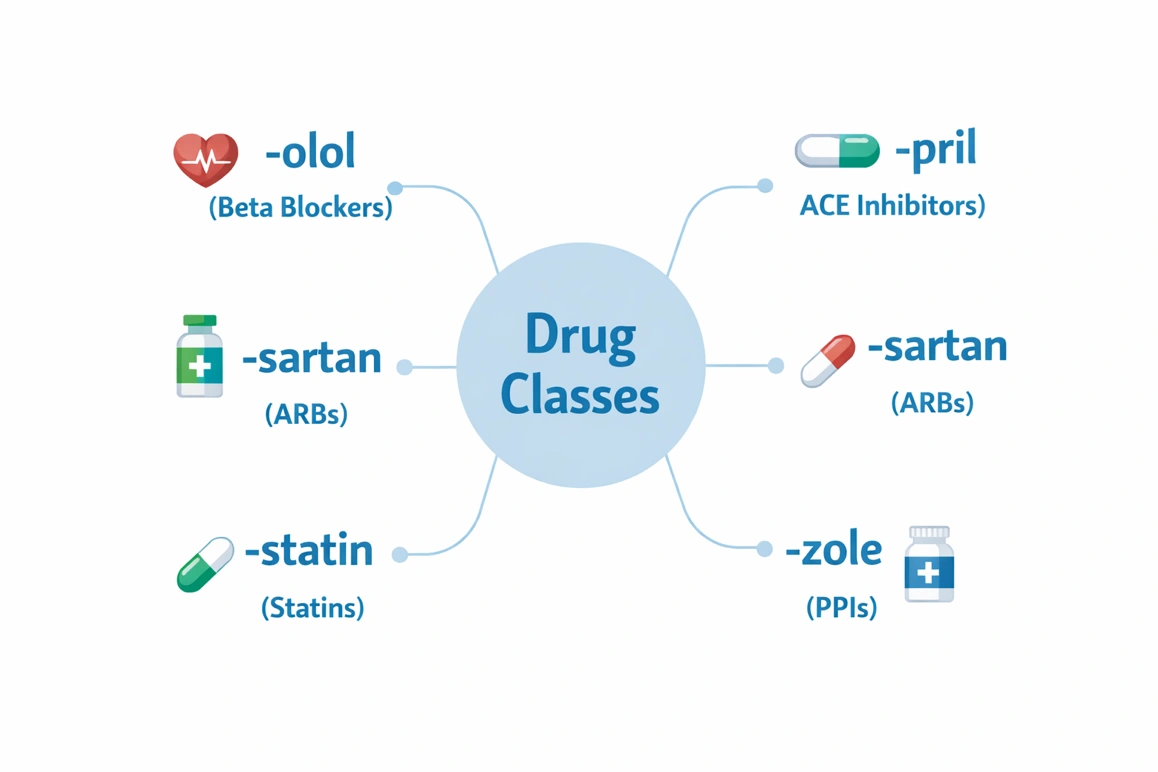
The solution: Learn drug CLASSES, not individual drugs.
Example:
Instead of memorizing 20 beta blockers individually, learn:
What beta blockers do: Lower heart rate and blood pressure
Suffix: -olol (metoprolol, atenolol, propranolol)
Key nursing considerations: Check HR and BP before giving. Hold if HR <60 or BP too low. Don't stop suddenly (rebound hypertension).
Side effects: Fatigue, dizziness, bradycardia
Now you know 20+ drugs using one concept.
How to study pharmacology:
Group drugs by class (ACE inhibitors, beta blockers, diuretics, etc.)
Create flashcards for each CLASS
Focus on nursing implications (what do YOU do as the nurse?)
Practice prioritization (patient on multiple drugs, which do you give first?)
Brigo for pharmacology: Generate flashcards automatically from your pharm notes. Cards include drug class, mechanism, nursing considerations, and side effects. Study 10-15 pharm cards daily using Daily 5.
2. Pathophysiology (Connecting Diseases to Symptoms)
The problem: Memorizing diseases feels random.
The solution: Understand the PATHOPHYSIOLOGY (what goes wrong in the body).
Example: Heart Failure
Don't memorize: "Heart failure symptoms are SOB, edema, fatigue"
Instead, understand WHY:
Heart can't pump effectively
Blood backs up into lungs → shortness of breath (SOB)
Blood backs up in body → fluid retention → edema in legs
Less oxygen delivered to body → fatigue
Now you understand heart failure forever.
How to study pathophysiology:
For each disease, ask: "What broke?"
Trace the domino effect (what happens next?)
Connect symptoms to the underlying problem
Link treatments to the pathophysiology (why does this drug work?)
Flashcard example:
Front: "Why does heart failure cause pulmonary edema?" Back: "Weak left ventricle can't pump blood forward → blood backs up into lungs → fluid leaks into alveoli → pulmonary edema"
3. Lab Values (Memorization Hacks)
The problem: Too many lab values to remember.
The solution: Focus on CRITICAL values and patterns.
Critical lab values you MUST know:
LabNormal RangeCritical LowCritical HighPotassium (K+)3.5-5.0<3.0 (cardiac arrhythmias)>6.0 (cardiac arrest risk)Sodium (Na+)135-145<120 (seizures)>160 (neuro changes)Glucose70-110<70 (hypoglycemia)>300 (DKA risk)Hemoglobin12-16 (F), 14-18 (M)<7 (transfusion needed)>18 (polycythemia)
Memorization hack:
Potassium = "Cardiac electrolyte"
Too low → weak heart rhythm
Too high → heart stops
Think: "Keep potassium perfect or the heart suffers"
Create flashcards for critical values ONLY. Don't waste time memorizing every lab value. Focus on the ones that kill patients if abnormal.
Generate lab value flashcards automatically with Brigo
4. Med-Surg Nursing (The Foundation)
Med-Surg is the foundation of all nursing. Master these systems:
Cardiovascular: MI, heart failure, hypertension, arrhythmias Respiratory: COPD, asthma, pneumonia, pulmonary embolism Endocrine: Diabetes (Type 1 & 2), thyroid disorders Renal: Acute kidney injury, chronic kidney disease, dialysis Neuro: Stroke, seizures, increased ICP
Study strategy:
For each condition, create a one-page summary:
Pathophysiology (what's broken?)
Symptoms (what does the patient look like?)
Diagnostics (what tests confirm it?)
Treatment (what fixes it?)
Nursing care (what do YOU do?)
Upload your Med-Surg notes to Brigo and generate comprehensive flashcard decks for each body system.
The Complete NCLEX Prep Timeline
When to start: 6 months before your NCLEX date.
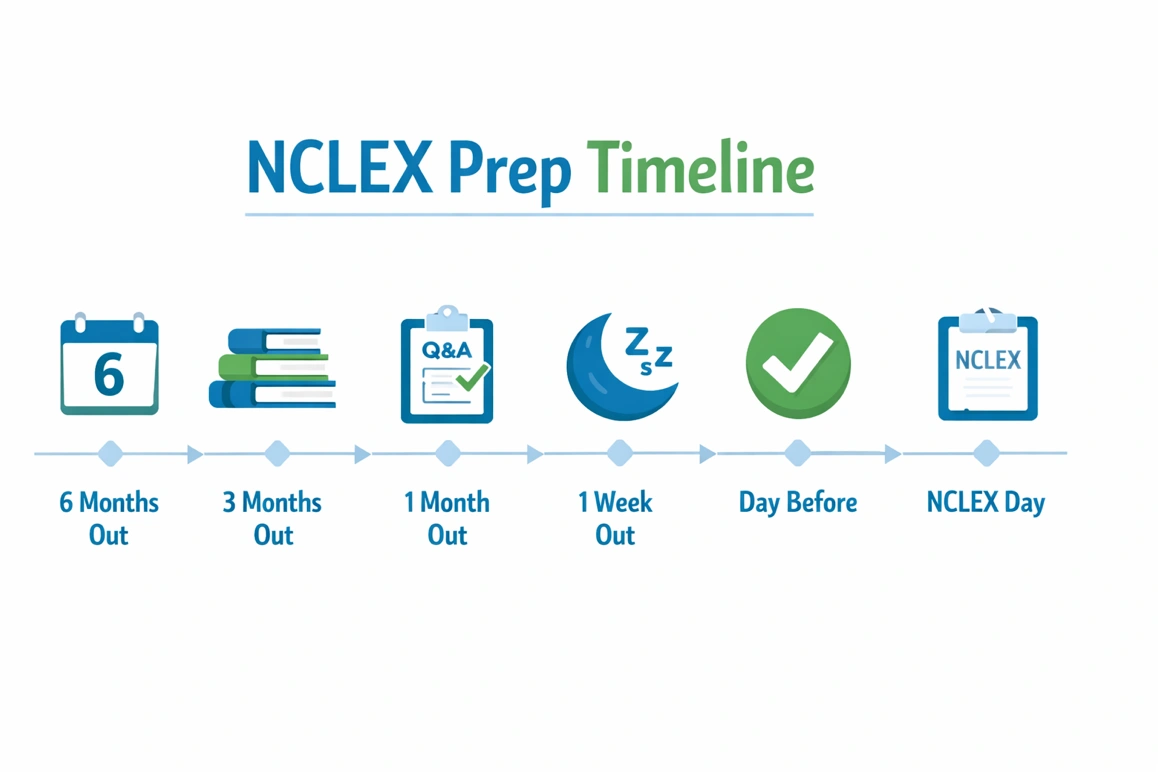
6 Months Out: Build Foundation
Goal: Solid understanding of core content
What to do:
Review weak areas from nursing school
Start doing 25-50 NCLEX questions daily
Focus on understanding rationales (why is this answer correct?)
Use Brigo's exam prediction to identify high-yield NCLEX topics
Study schedule:
1-2 hours daily
Focus on one system per week (cardiac week, respiratory week, etc.)
Build flashcard decks for each system
3 Months Out: Practice Mode
Goal: 75%+ pass rate on practice questions
What to do:
Increase to 75-100 NCLEX questions daily
Take full-length practice exams weekly
Analyze every wrong answer (WHY did you miss it?)
Drill weak content areas with flashcards
Study schedule:
3-4 hours daily
Morning: Practice questions
Afternoon: Review rationales and study weak areas
Evening: Flashcard review (30-50 cards)
Brigo Daily 5: Even during intense NCLEX prep, maintain your Daily 5 streak. It keeps you consistent and prevents burnout.
1 Month Out: Final Push
Goal: 85%+ pass rate, confidence building
What to do:
Mock NCLEX exams (full 145 questions, timed)
Focus ONLY on weak areas now
Review prioritization and delegation heavily
Practice alternate format questions (SATA, drag-and-drop)
Study schedule:
4-5 hours daily
Weekly mock exams
Daily review of high-priority content
Red flag: If your practice scores are <70%, consider delaying your NCLEX date. It's better to pass on the first try than fail and have to retest.
1 Week Out: Taper and Confidence
Goal: Mental preparation, light review
What to do:
Reduce study hours (4-5 hours daily → 2-3 hours)
Light review of one-page summaries
Practice 25-50 questions daily (keep your brain sharp but don't cram)
Sleep 8+ hours every night
Don't:
Cram new content
Pull all-nighters
Panic
Day Before NCLEX:
No studying (seriously)
Light exercise (walk, yoga)
Prepare logistics (ID, confirmation, directions to test center)
Early bedtime
Morning of NCLEX:
Light breakfast (don't test on empty stomach)
Arrive 30 minutes early
Trust your preparation
Learn how to handle exam day anxiety
Why Brigo Was Built Specifically for Nursing Students
Let me take you back to the moment Brigo was born.
I watched Bridget spend 45 minutes creating flashcards for one pharmacology lecture. Just typing drug names, mechanisms, side effects into Quizlet.
By the time she finished making the cards, she was too exhausted to actually study them.
That's when I thought: "What if AI could do this in 30 seconds?"
So I built it.
But it wasn't just about flashcards. Nursing students need:
1. Exam Prediction for NCLEX-Style Questions
The problem: Nursing exams are pattern-based, but you don't see the patterns until it's too late.
Brigo's solution:
Upload your past nursing exams and lecture notes AI analyzes them to identify:
Topics that appear repeatedly (fluid/electrolytes always shows up)
Question formats your professor loves (prioritization questions? delegation?)
High-probability topics for upcoming exams
You get a prioritized study list: "Focus 70% of your time on these 5 topics"
Result: You study what actually matters, not what's just "in the textbook."
2. AI Flashcards for Massive Terminology
The problem: Nursing school has thousands of terms to memorize. Creating flashcards manually takes forever.
Brigo's solution:
Upload your notes (lecture slides, textbook chapters, handouts) AI generates flashcards in 30 seconds Each card includes:
Question (What does this drug do?)
Answer (Mechanism of action)
Context (Why it matters for nursing care)
Example: Pharmacology lecture on beta blockers
Upload 15 pages of notes → Brigo generates 60 cards covering:
Drug names and suffixes
Mechanisms of action
Side effects and contraindications
Nursing considerations
Priority interventions
You spend your time studying, not typing.
3. Audio Notes for Clinical Commutes
The problem: Clinicals take 8-12 hours. You're exhausted. But you still need to study.
Brigo's solution:
Convert your notes into audio Listen during your commute to clinicals Review while getting ready, walking to class, or doing chores
Passive review while you live your life.
4. Daily 5 for Brutal Nursing School Schedules
The problem: Nursing school schedules are insane. Finding 2 hours to study every day feels impossible.
Brigo's solution:
Daily 5 Challenge: Study just 5 flashcards a day. Takes 2 minutes.
Why this works:
Consistency beats intensity (5 cards daily = 150 cards/month)
Builds habit without burnout
Your pet depends on you (gamification = accountability)
Streak tracking (breaking a 30-day streak feels terrible, keeps you going)
Real nursing student feedback:
"I don't have time to study for hours. But I ALWAYS have 2 minutes for my Daily 5. It kept me sane during my busiest semester." - Sarah, BSN student
Start your Daily 5 streak today
5. Case Study: How Sarah Used Brigo for Nursing School
Sarah's situation:
Second-year BSN student
Struggling with Med-Surg (too much content)
Working part-time + clinical rotations
Felt constantly behind
What she did:
Week 1:
Uploaded all Med-Surg lecture notes to Brigo
Generated flashcard decks for cardiac, respiratory, and renal systems
Started Daily 5 (studied 5 cards every morning)
Week 2-8:
Continued Daily 5 consistently
2 weeks before exams: used Exam Prediction
AI identified that her professor heavily tests cardiac conditions and prioritization questions
Focused 70% of study time there
Results:
Med-Surg Exam 1: 76% (passed, but not great) Med-Surg Exam 2: 88% (after using exam prediction) Final exam: 91%
Her feedback:
"Brigo didn't just help me pass. It gave me TIME back. I wasn't spending hours making flashcards or guessing what to study. The exam prediction told me exactly where to focus, and I actually had time to sleep before exams. Game-changer."
Surviving the Mental and Emotional Challenge
Let's talk about something nursing school doesn't prepare you for: the emotional toll.
Imposter Syndrome Is Normal
The voice in your head:
"Everyone else seems to understand this better than me." "I'm going to fail out and never become a nurse." "Maybe I'm not cut out for this."
The truth:
60-80% of nursing students experience imposter syndrome.
You're surrounded by smart, capable people who ALSO feel like they're faking it. The difference is they don't talk about it.
How to cope:
Talk to classmates (you'll realize everyone's struggling) Focus on YOUR progress, not comparing to others Celebrate small wins (passed an exam? That's huge!) Remember: feeling overwhelmed doesn't mean you're failing
Burnout Prevention
Signs you're burning out:
Can't focus even when you try Feeling numb or emotionally flat Physical exhaustion that sleep doesn't fix Losing passion for nursing Irritability, mood swings
How to prevent burnout:
Daily 5 approach: Small, sustainable study habits (not marathon cram sessions) Sleep is non-negotiable: 7-8 hours minimum Exercise: Even 20-minute walks help Social connection: Don't isolate yourself Therapy/counseling: No shame in getting professional support
When to Ask for Help
Ask for help if:
You're failing a class despite studying hard You're experiencing severe anxiety or depression You're thinking about quitting nursing school You're consistently sleeping <5 hours a night
Where to get help:
Campus counseling services (usually free) Academic advisor or nursing program coordinator Study groups or peer tutoring Professional therapist (if needed)
Asking for help is a sign of strength, not weakness.
Balancing Clinicals and Studying
The clinical rotation challenge:
You're at the hospital 8-12 hours, on your feet, exhausted.
You come home and still need to:
Write a care plan
Study for next week's exam
Prep for skills check-off
Do assigned readings
How to survive:
Study During Clinical Downtime
Bring flashcards (physical or on your phone)
During breaks, study 5-10 cards Review drug cards before administering medications Look up conditions your patients have
Audio notes during commute:
Listen to lecture notes on the drive to/from clinical Passive review while you're doing other things
Connect Clinical Experience to Theory
After each clinical day, ask:
What conditions did my patients have? What medications did I administer? What nursing interventions did I perform? How does this connect to what I learned in class?
This reinforces learning without extra study time.
Use Brigo's Mobile App
Clinical shifts are unpredictable. You might have 15 minutes between patients or 2 hours of downtime.
Brigo's mobile app lets you:
Study flashcards anywhere (no need for laptop) Quick review during breaks Pick up exactly where you left off Complete Daily 5 during lunch break
Download Brigo for iOS/Android
FAQ: Nursing Student Questions Answered
Q: How many hours should I study per day in nursing school?
A: It varies by semester and course load, but here's a general guideline:
First year: 2-3 hours daily (building foundation) Second year: 3-4 hours daily (more intense) Third/fourth year: 2-3 hours (you're more efficient now) NCLEX prep: 3-5 hours daily (final push)
Quality over quantity. 2 focused hours using active recall beats 5 hours of passive reading.
Q: What's the best way to memorize drug names?
A: Learn drug CLASSES, not individual drugs. Focus on suffixes:
-olol = beta blockers -pril = ACE inhibitors -sartan = ARBs -statin = cholesterol meds -zole = proton pump inhibitors
Once you know the class, you know the mechanism, side effects, and nursing care for 20+ drugs at once.
Use flashcards to drill drug classes daily.
Q: When should I start NCLEX prep?
A: 6 months before your expected test date.
Don't wait until after graduation. Start during your final semester:
Build content knowledge while it's fresh
Practice questions daily
Identify weak areas early
If you wait until graduation, you'll have forgotten too much and need to relearn everything.
Q: What if I fail a nursing exam?
A: First, don't panic. One failed exam doesn't mean you'll fail the class.
Do this immediately:
Calculate if you can still pass the class (use the formula from our failing class guide)
Talk to your professor (ask what you missed, what to focus on)
Analyze what went wrong (didn't know content? poor test-taking? time management?)
Adjust your study strategy (use exam prediction to focus better next time)
Recovery is possible. Many successful nurses failed exams in school.
Q: How do I balance clinicals and studying?
A: Time management is key:
Use clinical time productively:
Study flashcards during breaks
Look up your patients' conditions
Practice critical thinking in real-time
Weekends for heavy studying:
Use weekdays for light review (Daily 5)
Save deep study sessions for weekends
Audio notes during commutes:
Turn drive time into study time
Accept imperfection:
Continue
03:32
You can't study 4 hours on clinical days
That's okay. Consistency > intensity.
Q: Is Brigo worth it specifically for nursing students?
A: Honest answer: Yes, if you're willing to use it consistently.
Brigo saves nursing students 10+ hours per week:
45 minutes making flashcards → 30 seconds with AI
Hours guessing what to study → Exam prediction tells you exactly where to focus
Scattered notes → Everything organized in one app
Cost: $17.99/semester
ROI: Pass your exams, graduate on time, become a nurse. Worth it.
Free tier available to try before committing.
The Bottom Line: You Can Pass Nursing School (With the Right System)
Here's what I learned watching Bridget go through nursing school:
The students who pass aren't necessarily the smartest.
They're the ones with the best SYSTEMS.
They don't study harder. They study smarter.
They don't memorize everything. They prioritize ruthlessly.
They don't burn out. They build sustainable habits.
Your nursing school survival checklist:
✅ Focus on high-yield topics (use exam prediction to identify them) ✅ Use active recall (flashcards, not re-reading) ✅ Build consistency (Daily 5 beats marathon study sessions) ✅ Master NCLEX-style questions (prioritization, ABC, nursing process) ✅ Connect theory to clinicals (real patients = best learning) ✅ Take care of your mental health (burnout prevention is non-negotiable) ✅ Use tools built for nursing students (generic apps don't understand your needs)
Ready to stop struggling and start thriving in nursing school?
Download Brigo - the study app built specifically for nursing students.
What you get:
✅ AI-powered exam prediction (know what to study before the exam) ✅ Instant flashcard generation (stop wasting hours creating cards) ✅ Daily 5 Challenge (build sustainable study habits) ✅ Audio notes (study during clinical commutes) ✅ Pet accountability system (gamification that actually works) ✅ Mobile app (study anywhere, anytime)
Free trial available. No credit card required.
Join thousands of nursing students who've already discovered the smarter way to study.
You didn't get into nursing school by accident. You're capable. You're smart. You just need better tools.
Let Brigo be your study partner. Built by someone who watched a nursing student struggle. Designed for students like you.
Questions? Email us at support@brigo.app - we're here to help you succeed.
Already using Brigo? Share your story with us! We'd love to hear how it's helped you.
Additional Resources for Nursing Students
Official NCLEX Resources: NCSBN NCLEX Test Plan - Official exam blueprint
Free Study Resources: RegisteredNursing.org - Free NCLEX practice questions Khan Academy Medicine - Video lessons on pathophysiology
Mental Health Support: Mental Health Resources - Crisis support and counseling
Nursing Communities: r/StudentNurse - Reddit community for nursing students AllNurses.com - Forum for nursing students and professionals
Related Brigo Blog Posts:
How to Master Active Recall with AI Flashcards
Complete Guide to Exam Prediction
How to Study When You Have No Motivation
You've got this. Now go become the nurse you were meant to be.
Claude is AI and can make mistakes.
Please double-check responses.