
I'm Failing My Class: A Student's Step-by-Step Recovery Plan

You just checked your grade portal.
Your stomach drops. Your hands shake slightly as you refresh the page, hoping it's a mistake.
It's not.
You're failing. Or close to it. That number on the screen doesn't look like the grade of someone who's going to pass.
Week 10 of 15. Maybe Week 12. The final is coming. That major project is due. And you're so far behind that catching up feels impossible.
The panic sets in. Then the shame. "How did I let this happen? What's wrong with me?"
Maybe you stopped going to class. Or you went but didn't really pay attention. The assignments piled up. You kept telling yourself "I'll catch up this weekend" and then... you didn't.
Now you're here. Reading this post. Desperate for a way out.
Here's what I need you to hear: It's not over.
I'm not going to lie to you. Recovery won't be easy. You've got a lot of ground to cover in very little time.
But it is possible. With the right plan, the right focus, and the right tools, you can still pass this class.
This post is your step-by-step recovery plan. Everything you need to do in the next 2-4 weeks to turn this around.
Let's fix this.
Step 1: Reality Check - Can You Actually Still Pass?
Before you panic or give up, let's do the math.
Calculate Your Rescue Grade
You need three pieces of information:
1. Your current grade (check your grade portal) 2. Weight of remaining assignments (check your syllabus) 3. Minimum passing grade (usually 60% or 70%, check your syllabus)
Use this formula:
Grade Needed = (Passing Grade - (Current Grade × Weight of Completed Work)) ÷ Weight of Remaining WorkExample:
Current grade: 45% Completed work: 60% of final grade Remaining work: 40% of final grade (final exam + last project) Passing grade: 60%
Grade Needed = (60 - (45 × 0.60)) ÷ 0.40
Grade Needed = (60 - 27) ÷ 0.40
Grade Needed = 33 ÷ 0.40
Grade Needed = 82.5%
So you'd need to score 82.5% on your remaining assignments to pass with a 60%.
Use an online GPA calculator like RogerHub's Final Grade Calculator to make this easier.
Three Possible Outcomes:
Scenario 1: Still Possible (You need 90% or less)
Recovery is realistic. It'll be hard, but doable. Follow this entire plan.
Scenario 2: Very Difficult (You need 90-100%)
Possible, but you need perfection. Consider talking to your professor about extra credit. Follow this plan + seek additional help.
Scenario 3: Mathematically Impossible (You need >100%)
Time to consider dropping the class if you're within the drop deadline. Talk to your advisor immediately.
Important: Some professors offer extra credit or drop the lowest quiz. Check your syllabus. That could change your math.
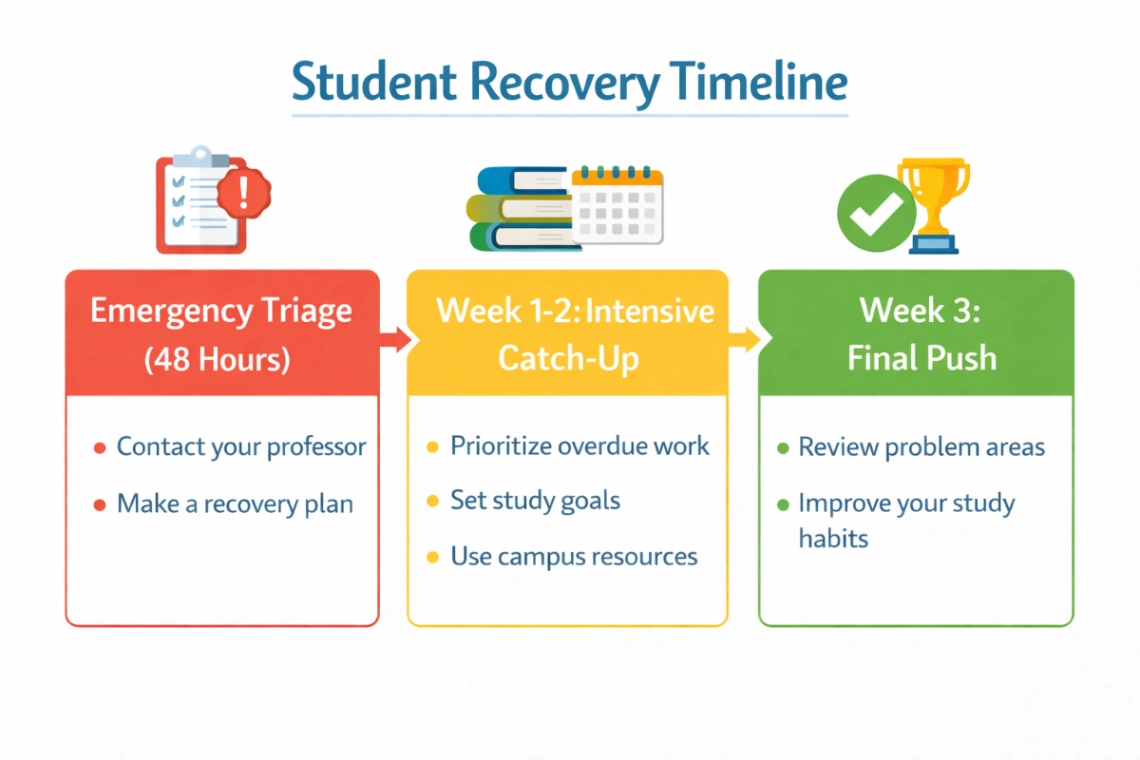
Step 2: The First 48 Hours (Emergency Triage)
You've done the math. If recovery is possible, here's what to do in the next 48 hours:
Hour 1-2: Get Organized
Download or print:
Your syllabus Grade breakdown (what's left and what it's worth) Exam dates Assignment due dates Professor's office hours
Create a simple spreadsheet:
AssignmentDue DateWeightCan I Still Complete?PriorityFinal ExamDec 1540%YesHIGHProject 3Dec 1020%YesHIGHQuiz 8Dec 55%YesMEDIUM
Sort by weight (highest first). This is your hit list.
Hour 3-4: Talk to Your Professor
This is non-negotiable. Most students avoid their professor out of shame. This is a mistake.
Go to office hours and say this:
"Professor [Name], I just checked my grade and I'm at [X%]. I know I've fallen behind and I take full responsibility. I want to do everything possible to pass this class. Can we talk about my options?"
What to ask:
"What are the most important topics for the final exam?" "Is there any extra credit available?" "If I do well on [final exam/project], is passing still possible?" "What would you recommend I focus on?"
Why this works:
Professors want students who show initiative and take responsibility. By showing up, you're demonstrating you care. Many professors will give you valuable intel (what's on the exam, which topics matter most) or even offer opportunities you didn't know existed.
Pro tip: Don't make excuses. Don't say "the class is too hard" or "I didn't understand." Just own it and ask for guidance.
Hour 5-8: Gather Your Materials
You need:
All lecture notes (borrow from classmates if you missed classes) All assigned readings Past exams or practice problems (ask seniors or check online) Study guides (if provided)
Upload everything to Brigo. More on this later, but having your materials organized in one place is critical.
Hour 9-48: Stop Digging the Hole Deeper
For the next 48 hours:
Attend every single class (even if you're behind) Take notes (even if you don't understand everything) Don't skip any more assignments (submit SOMETHING, even if it's not perfect) Get 7+ hours of sleep (you need your brain functioning)
Reality check: You can't afford to miss anything else. Zero tolerance.
Step 3: The 2-3 Week Recovery Plan
Now we build your recovery schedule. This depends on how much time you have left.
If You Have 3+ Weeks Left
Week 1: Foundation Building (Stop the Bleeding)
Goals: Attend every class Complete any overdue assignments (even for partial credit) Identify the 5 most important concepts/topics
Daily Schedule:
Morning (8-10 AM): Review yesterday's lecture notes Identify what you don't understand Watch a YouTube crash course or read textbook section
Afternoon (2-4 PM): Attend class Take detailed notes Ask at least one question
Evening (7-9 PM): Complete today's assignment (if any) Study 10-15 flashcards on priority topics Daily 5 on Brigo
Brigo Integration: Upload your notes and generate flashcards for core concepts. Focus on high-priority topics identified by Exam Prediction.
Week 2: Intensive Catch-Up (Build Momentum)
Goals: Master high-priority topics Complete practice problems or essays Study for final exam begins
Daily Schedule:
Morning (8-11 AM): Deep work on hardest topic Practice problems or writing Use AI flashcards for rapid learning
Afternoon (2-4 PM): Class + office hours Ask professor to review your practice work
Evening (7-10 PM): Study session #2: different topic Flashcard review (30-40 cards) Practice exam if available
Weekend: 4-6 hour study blocks with breaks Focus on synthesis (how topics connect) Create one-page summary sheets
Week 3: Final Push (Exam Prep)
Goals: Final exam mastery Project completion Confidence building
Daily Schedule:
Morning (8-12 PM): Practice exams under timed conditions Review mistakes intensively Flashcard drill on weak areas
Afternoon (2-5 PM): Class (if still meeting) Group study sessions Teach concepts to others (best way to learn)
Evening (7-10 PM): Final project work (if applicable) Last review of high-priority topics Early night before exam (sleep matters!)
3 Days Before Exam: Stop learning new material. Only review what you already studied.
1 Day Before Exam: Use the one-day cramming strategy. Light review, plenty of sleep.
If You Only Have 1-2 Weeks Left
You're in emergency mode. Focus is everything.
Ignore everything except:
Topics that will definitely be on the final (ask your professor or check past exams) The final exam itself (if it's weighted heavily) Any remaining high-value assignments
Use Brigo's Exam Prediction to identify the 20% of material that will give you 80% of the points. Study ONLY that.
Daily Schedule (Every Day Until Exam):
Morning (3 hours): Priority Topic #1 - deep study Flashcards + practice problems
Afternoon (2 hours): Priority Topic #2 Active recall testing
Evening (2 hours): Priority Topic #3 Practice exam or essay writing
Late Night: Light review + sleep (6+ hours minimum)
No days off. You're in sprint mode.
Step 4: Smart Study Strategies for Rapid Catch-Up
When you're behind, you can't study everything. You need surgical precision.
Strategy 1: The 80/20 Rule on Steroids
Pareto Principle: 80% of your exam grade will come from 20% of the material.
How to find that 20%:
Ask your professor: "What are the most important topics?" Check past exams: What appears repeatedly? Look at lecture time: Topics your professor spent multiple classes on matter more Use Exam Prediction: Let AI analyze your materials and identify patterns
Focus 90% of your time on this 20%. Everything else is bonus.
Strategy 2: AI-Powered Flashcards for Rapid Learning
You don't have time to spend 2 hours making flashcards. Let AI do it.
The Brigo Method:
Upload your lecture notes or textbook chapters Generate flashcards in 30 seconds Study using active recall (don't just read, quiz yourself) Focus on cards you get wrong
Why this works:
Active recall is proven to be significantly more effective than re-reading AI identifies the most important concepts automatically You spend time studying, not creating materials
Learn how to use flashcards effectively
Strategy 3: Practice Problems > Theory
If your class involves problem-solving (math, physics, chemistry, accounting):
Don't just read the textbook. DO PROBLEMS.
Find old exams Work through end-of-chapter problems Do practice problems until you can solve them without looking at answers
For every 1 hour of reading, do 2 hours of practice.
Strategy 4: Leverage Study Groups (The Right Way)
Study groups can save you if used correctly.
Good study group:
Everyone comes prepared with specific questions You take turns explaining concepts (teaching = learning) You quiz each other Time-limited (2 hours max)
Bad study group:
Becomes a social hangout One person does all the talking No one actually studies Lasts 4+ hours with no breaks
Use study groups to:
Fill in gaps (get notes you missed) Test your understanding (can you explain concepts?) Get different perspectives on hard topics
Strategy 5: Office Hours Are Your Secret Weapon
Your professor has office hours. Use them.
What to bring:
Specific questions (not "I don't understand Chapter 7") Practice problems you attempted but got wrong Your study plan (ask them to review it)
What to ask:
"Can you explain this concept in a different way?" "Is my approach to this problem correct?" "What's the best way to prepare for the final?"
Professors are more willing to help students who show effort and initiative.
Step 5: What NOT to Do (Common Mistakes That Make It Worse)
Don't Try to Learn Everything
You don't have time. Focus on high-priority topics and accept you'll have gaps.
Better to know 60% of the material deeply than 100% superficially.
Don't Pull All-Nighters Repeatedly
One all-nighter before the final? Okay (not ideal, but survivable).
Multiple all-nighters? You're destroying your cognitive function. Sleep is when your brain consolidates memory. Without it, you won't remember what you studied.
Minimum sleep: 5-6 hours per night.
Don't Avoid Your Professor
Hiding makes it worse. Professors can't help if they don't know you're struggling.
Face the awkwardness. It's worth it.
Don't Give Up Without Trying
Even if recovery seems impossible, try. You might be surprised.
And even if you don't pass, you'll learn valuable lessons about work ethic and resilience that matter more than one grade.
Step 6: Mental and Emotional Survival
Failing a class hits hard. Here's how to handle the emotional side:
Dealing with Shame and Guilt
The voice in your head: "I'm so stupid. Everyone else can do this. What's wrong with me?"
The truth: Thousands of students fail classes every semester. You're not uniquely broken. You made mistakes. Now you're fixing them.
Reframe: This is a learning experience, not a life sentence.
How to Tell Your Parents (If You Need To)
If you're financially dependent on your parents, you might need to tell them.
What to say:
"I need to tell you something difficult. I'm failing [class name]. I take full responsibility. I've already met with my professor and created a recovery plan. Here's what I'm doing to fix it..."
Then show them this plan.
Parents are more understanding when they see you're being proactive, not making excuses.
Managing Stress During Recovery
You will feel overwhelmed. That's normal.
Coping strategies:
Break work into small chunks (Pomodoro: 25 min work, 5 min break) Exercise (even 10-minute walks help) Talk to someone (friend, counselor, family) Remember: This is temporary
If you're feeling hopeless or having dark thoughts: Talk to a counselor immediately. Find mental health resources here or contact your campus counseling center.
Your mental health is more important than any grade.
When to Consider Dropping the Class
Drop if:
Recovery is mathematically impossible You're failing multiple classes (can't recover all) The stress is affecting your physical/mental health severely You're past the point where you can learn the material adequately
Talk to your academic advisor first. They can help you understand the implications (financial aid, graduation timeline, GPA impact).
Dropping isn't failure. Sometimes it's the smart strategic move.
Step 7: Prevention - Never Let This Happen Again
Once you recover (or if you don't), here's how to prevent this next semester:
Early Warning Signs You Missed
You were probably showing these signs weeks ago:
Missing classes occasionally Skipping readings "just this once" Not understanding lectures but not asking questions Assignments piling up Feeling overwhelmed but not seeking help
These are red flags. Next time, intervene early.
Build Anti-Fragile Study Systems
The Daily 5 Method:
Study just 5 flashcards every day. That's it. No motivation required.
Do this consistently and you'll never fall behind again.
Start the Daily 5 Challenge on Brigo
Weekly Review Habit:
Every Sunday, review what you learned that week (30 minutes) Identify anything you don't understand Get help before it compounds
Attend Class (Non-Negotiable):
Even if you're tired. Even if you don't feel like it. Just show up.
80% of success is showing up consistently.
Use Tools That Prevent Falling Behind
Brigo's system helps you stay on track:
Daily 5 keeps you consistent (streak tracking + pet accountability) Weekly exam predictions show you what to prioritize Flashcards help you review incrementally, not cram
Download Brigo and build habits that prevent crisis mode.
FAQ: Your Failing Class Questions Answered
Q: Is it too late to pass my class?
A: Do the math (Step 1). If you need less than 100% on remaining work, it's not too late. If you need >100%, talk to your professor about extra credit or consider dropping.
Q: Should I drop the class or try to recover?
A: Factors to consider:
How much do you need on remaining work? (If <90%, try to recover) Will dropping affect financial aid or graduation timeline? (Check with advisor) Are you failing other classes too? (Can't recover everything at once) Is your mental health at risk? (Health > grades)
Q: Will this destroy my GPA forever?
A: One failing grade hurts, but it's not permanent. If you retake the class and pass, many schools replace the F with your new grade in GPA calculations. Check your school's policy.
Even if it doesn't replace, you have future semesters to raise your GPA.
Q: What if I'm failing multiple classes?
A: Focus on the one you're closest to passing and/or the one most important for your major. You might need to drop 1-2 classes to save the others. Talk to your advisor immediately.
Q: How do I explain this to my parents?
A: Be honest, take responsibility, show them your recovery plan. Parents respect accountability and action more than excuses.
Q: What if I've never failed before and I'm freaking out?
A: Your identity isn't tied to perfect grades. Failure is a learning experience. Some of the most successful people failed classes in college. This doesn't define you.
Q: My professor hates me. Will they help?
A: Most professors don't hate students. They're frustrated by students who don't try. Show up, show effort, take responsibility, and most will help you.
The Bottom Line: Recovery Is Possible, But You Have to Act Now
Here's the truth: Reading this post won't save you. Taking action will.
You have a choice right now:
Option 1: Close this tab, go back to avoiding the problem, and fail.
Option 2: Follow this plan, starting in the next hour, and fight for your grade.
Which version of yourself do you want to be?
Your Recovery Action Plan (Start Right Now):
Next 1 Hour: Calculate what grade you need to pass Pull up your syllabus Identify remaining assignments
Next 24 Hours: Email professor to schedule office hours Gather all notes and materials Upload materials to Brigo and generate your first flashcard deck
Next Week: Follow Week 1 schedule (Foundation Building) Attend every class Complete Daily 5 flashcards Start practice problems
Until Final Exam: Execute the plan Adjust as needed Don't give up
You've got this. Not because it's easy. But because you're going to put in the work.
Need tools to execute this plan? Download Brigo and use AI-powered exam prediction and flashcards to focus your recovery efforts.
Questions about your situation? Email us at support@brigo.app - we've helped hundreds of students in crisis mode.
Struggling with motivation to start? Read our guide on studying with zero motivation
Resources That Can Help
Final Grade Calculator - Calculate what you need to pass
Khan Academy - Free video lessons on almost any subject
Crash Course (YouTube) - Quick review videos
Mental Health Resources - If you're struggling emotionally
[Your Campus Academic Support Center] - Free tutoring and study help
Stop reading. Start recovering. You can do this.